Don't forget to also check out a great recap of the symposium that took place on Jan 14th. If you haven't seen Padi and his new case or the new exhibit, make your way over to the MGH Paul S. Russell, MD Museum of Medical History and Innovation.
Sunday, January 26, 2014
Harvard Magazine Article and More
We had a wonderful Panel and Lecture at the MGH Ether Dome last week. Padihershef has a wonderful article in the Harvard Magazine. Please check it out!

Friday, November 22, 2013
MGH Sends Support
Thank you to all the supporters of the disaster relief in the Philippines-- MGH sends team to Philippines
 |
| MGH Team sent to Philippines for support (Photo courtesy of MGH) |
Tuesday, October 22, 2013
Mimi Blogged
Hey everyone check out Mimi's interview with the Peabody Essex Museum blog Connected. Mimi talks about her history with mummies and the Padihershef conservation treatment weekend.
Mimi and Mummys
Mimi and Mummys
Monday, September 30, 2013
Some Mummy Resources
Check out these other great articles on other mummies around the world.
Unwrap A Mummy
A museum in Sweden is now offering a great interactive where you can "unwrap" a mummy. This was created by compiling numerous CT scans and xrays. The exhibit is set to open in Spring of 2014.
Perth Mummy CT Scanning
Just like Padihershef, this mummy has waited thousands of years for a CT scan. There is also a project in the works to document and make an international database of human and animal remains. Perhaps one day Padi will be in the database!
Scanning Animal Mummies
This is a small clip of the Brooklyn Museum's animal mummy x-ray and CT scanning project. This will help museum professionals and researchers learn more about the animals life, mummification process and more.
Unwrap A Mummy
A museum in Sweden is now offering a great interactive where you can "unwrap" a mummy. This was created by compiling numerous CT scans and xrays. The exhibit is set to open in Spring of 2014.
Perth Mummy CT Scanning
Just like Padihershef, this mummy has waited thousands of years for a CT scan. There is also a project in the works to document and make an international database of human and animal remains. Perhaps one day Padi will be in the database!
Scanning Animal Mummies
This is a small clip of the Brooklyn Museum's animal mummy x-ray and CT scanning project. This will help museum professionals and researchers learn more about the animals life, mummification process and more.
Monday, July 29, 2013
The 8th Mummy Congress in Rio de Janeiro
Mimi Leveque, conservator from the Peabody Essex Museum in Salem, Ma, will be participating at the 8th Mummy Congress in Rio de Janeiro, Brazil. She will be writing and giving a talk about the whole Padihershef conservation, CT scan and facial reconstruction project. In addition, Mimi will go in depth about the benefits of social media interest with mummy projects.
Please cheer her on as she will be giving her talk next week. The Mummy Congress starts August 6th and runs until August 9th.
http://www.museunacional.ufrj.br/novidades/8o-congresso-mundial-de-estudos-de-mumias
Check out her abstract below:
(Abstract written by Mimi Leveque)
Please cheer her on as she will be giving her talk next week. The Mummy Congress starts August 6th and runs until August 9th.
http://www.museunacional.ufrj.br/novidades/8o-congresso-mundial-de-estudos-de-mumias
Check out her abstract below:
Padihershef,
the Oldest Patient in the Ether Dome at the Massachusetts General Hospital,
Gets a 21st Century Re-Examination, MIMI LEVEQUE (Conservator, Peabody
Essex Museum, Salem, MA and ArchaeaTechnica Conservation, mimi_leveque@pem.org.
For 190 years Padihershef, the
first Egyptian mummy in America, has watched major medical technological
changes from his home in the Ether Dome but only now has he become a recipient
of their benefits. In 2013, MGH embarked on a comprehensive conservation project
to examine, treat and rehouse the mummy and his coffin, under the direction
of the Paul S. Russell, MD Museum of History and Innovation. We
hope to acquire as much data as possible about the methods of mummification,
the condition of the body and the wrappings, his state of health and how he
compares to other mummies of his time and place.
The project has begun with
radiographic imaging, including plain film x-rays, 2 D and 3 D CT scans, done by a team led by Dr. Rajiv Gupta, Director,
Ultra-high Resolution Volume CT Lab using
Siemens Definition Flash Scanner at 120kVp, 350mAs, 1 second rotation time,
pitch of 0.5 and a slice thickness of 0.5mm.
The data has also been sent to
Jonathan Elias, Director of the Akhmim Mummy Studies
Consortium to produce a sculptural forensic facial reconstruction of
Padihershef. This part of the work will require an accurate skull model
digitally edited and then rapid prototyped, printed in full 3D volume.
The
conservation treatment, directed by the author, will involve a condition
assessment and stabilization of both the mummy and coffin. As an educational outreach, the treatment
phase will be open to the public over a three day period in the Ether Dome,
MGH’s original surgical teaching amphitheater.
All the data
will be shared by postings to the Padihershef Facebook page and a dedicated
blog, written by Rebecca Barber of the Peabody Essex Museum. This paper will summarize the findings and
discuss the benefits of social media in expanding the public’s interest in
scientific projects.
 |
| Mimi Leveque speaking with press (Photo courtesy of MGH photographer) |
Saturday, July 6, 2013
Padihershef at the MFA
Did you know that Padihershef's outer coffin was once stored at the Museum of Fine Arts Boston?
Thank you Mimi Leveque, Peabody Essex Museum conservator, for sending this great photo of Padihershef's outer coffins at the Museum of Fine Arts Boston. This photo was taken at the MFA in 1909 when the museum was still at Copley Square.
Can you point out Padi's outer coffins in the picture? (Answer below)

Below is a another picture of the MFA in the late 19th century.

We believe the outer coffin photo was taken near the windows at the far right bottom corner of the picture. Talk about great provenance for Padihershef.
Answer: The outer coffins are on the outside (like bookends) of the other mummies' coffins.
Thank you Mimi Leveque, Peabody Essex Museum conservator, for sending this great photo of Padihershef's outer coffins at the Museum of Fine Arts Boston. This photo was taken at the MFA in 1909 when the museum was still at Copley Square.
Can you point out Padi's outer coffins in the picture? (Answer below)

Below is a another picture of the MFA in the late 19th century.

We believe the outer coffin photo was taken near the windows at the far right bottom corner of the picture. Talk about great provenance for Padihershef.
Answer: The outer coffins are on the outside (like bookends) of the other mummies' coffins.
Friday, June 14, 2013
Shout out to Mimi! Conservation with Cotton Swabs
Thanks to Mimi Leveque for her hard work on the Padihershef conservation project.
Check out this great interview on Mimi's conservation techniques from NPR.
http://www.npr.org/2013/06/11/190756396/spit-and-cotton-swabs-the-tools-for-a-mummy-facelift
Mimi used many tools and techniques to clean Padihershef and his coffin. Some of the greatest tools for conservation are, believe it or not, cotton swabs and saliva. Yes, saliva is one of the best cleaning solutions conservators can use to remove dust, salts, grime, etc. Because of the enzymes in saliva (the very same that help break food), conservators can carefully remove particles. What a useful tool and significant part of the mummy restoration process.
Thank you again Mimi!


Stay tuned for future discussions on our blog pertaining to other techniques Mimi used on Padihershef's coffin and textiles.
Check out this great interview on Mimi's conservation techniques from NPR.
http://www.npr.org/2013/06/11/190756396/spit-and-cotton-swabs-the-tools-for-a-mummy-facelift
Mimi used many tools and techniques to clean Padihershef and his coffin. Some of the greatest tools for conservation are, believe it or not, cotton swabs and saliva. Yes, saliva is one of the best cleaning solutions conservators can use to remove dust, salts, grime, etc. Because of the enzymes in saliva (the very same that help break food), conservators can carefully remove particles. What a useful tool and significant part of the mummy restoration process.
Thank you again Mimi!

Mimi Leveque talking about the salts on Padihershef's skin

Mimi Leveque observing Padihershef in the Ether Dome- MGH
Stay tuned for future discussions on our blog pertaining to other techniques Mimi used on Padihershef's coffin and textiles.
Saturday, June 8, 2013
Large Turn Out for Padihershef
About 450 people stopped by yesterday to witness the conservation of Padihershef. What a great turn out! This included media from Boston Globe, NPR and more.
Mimi Leveque worked on removing salts (also known as efflorescence) from Padihershef's face.
We will continue for this Saturday and Sunday to finish the coffin, his burial shroud, and rehouse the mummy into his new stable display case. This will help protect Padi from future damage and help to preserve him for future generations.
What an exciting time for Padihershef and the MGH Hospital.
 Visitors coming to witness Padihershef's makeover
 Mimi taking a few moments to talk with the Press
Mimi Leveque worked on removing salts (also known as efflorescence) from Padihershef's face.
We will continue for this Saturday and Sunday to finish the coffin, his burial shroud, and rehouse the mummy into his new stable display case. This will help protect Padi from future damage and help to preserve him for future generations.
What an exciting time for Padihershef and the MGH Hospital.


Friday, June 7, 2013
Don't forget to stop by the Ether Dome at MGH today. The conservation treatment of Padihershef will start today and conclude Sunday. The public will be allowed access from 11 am to 3 pm. Look forward to seeing everyone there.
Boston.com Link -More Information
Boston.com Link -More Information
Wednesday, June 5, 2013
Condition and Treatment of Padihershef in 2003
In 2003, Mimi Leveque, mummy conservator from the Peabody Essex Museum, helped in the conservation and preservation of Padihershef. Below are the drawings, conditions and part of Mimi's report from 2003.
 |
| Sketch of Padihershef's wrappings original appearance Photo and sketch by Mimi Leveque |
In 1823, Dr. Warren opened Padi's coffin and revealed most of his wrappings and beading. Based on Dr. Warren's account Mimi has sketched a possible reconstruction of the wrappings and faience beaded netting.
"... the faience bead net had
deteriorated and lay at the feet, still partly retaining the linen threads that
joined them. The mummy was covered with
a shroud that was crossed by lighter bands at intervals. Below the crossing bands were remains of
darker bands that had nearly completely disintegrated due to the original
acidic dye. Dr. Warren cut through the shroud covering the head of the mummy, revealing
approximately 25 turnings of 3" wide linen bands. The outer layers were
well preserved but the inner layers were quite decayed, probably due to contact
with the oils and resins of embalming, that he called a "glutinous
substance". "
- Padihershef Condition and Treatment Report by Mimi Leveque
Condition of Padihershef
 |
| Padihershef, Sketch of the condition of the wrappings, netting and face Sketch by Mimi Leveque |
Over time, Padihershef stood in his case which caused deterioration of the netting, linens and body. There were polyethylene straps to keep Padi from falling out of his coffin, but this unfortunately compressed and crushed the linens below. Laying him down in his coffin would relieve the weight of gravity and help preserve the mummy and coffin as a whole.
There were many losses and holes in the fabric. These appear to be ancient. The face had evidence of efflorescence which is due to the salts from the embalming period.
Treatment 2003
Mimi was able to remove the reemerging efflorescence with a cotton swab and saliva. The linens were vacuumed with a small micro attachment on a low speed setting. The loose wrappings were pinned back lightly with insect pins. Padihershef was given a new backboard from Medex (while he was in Springfield). The backboard was covered in linen and quilt batting to cushion the mummy while it rested.
In the summer of 2013, a more in depth treatment will take place which will include conserving the coffin, laying Padihershef horizontally, treating the linens, and giving him a new plexi case.
Friday, May 31, 2013
"Words with a Mummy" The CT Scan Night
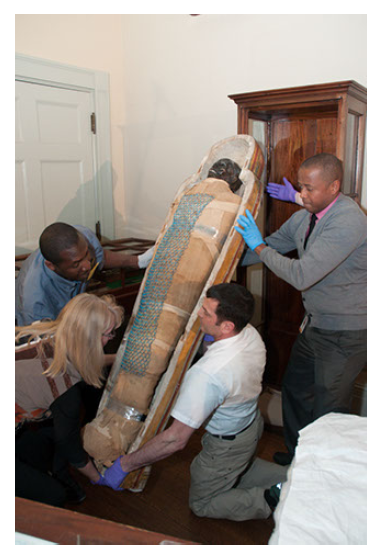
Back in March, MGH staff performed a CT scan on Padihershef to further understand his life and possible cause of death. The photos are now released below. Please check them out.
This CT Scan night was all performed and facilitated by the help of Rajiv Gupta, MD, PhD, of MGH Imaging; conservator Mimi
.Leveque; Collection's Specialist Rebecca Barber, MGH
neurosurgeon Paul Chapman, MD; and members of Materials
Management, Buildings and Grounds, and Police and Security.
http://www.massgeneral.org/imaging/about/newsarticle.aspx?id=4045


 |
Removing Padi from his old 19th century case was one of the hardest parts of the project |
 |
| Multiple times we needed to inspect Padihershef to make sure to prevent any damage to him and his coffin |
 |
| Mimi helping Padi into the gerny |
 |
| Security and facilities escorting Padi through MGH |
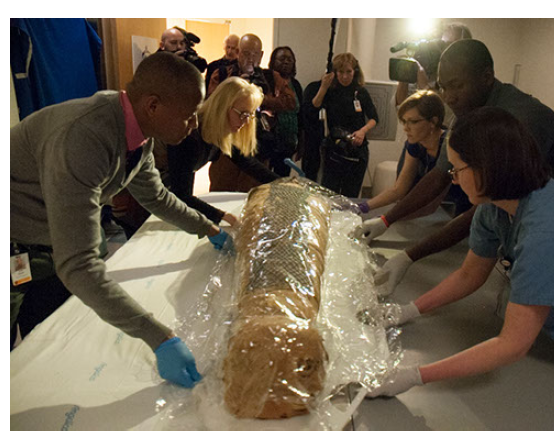 |
| As you can see the Padihershef was very popular with the media |


 |
| Dr. Gupta helping to get xrays of Padihershef |
 |
| The team realized there was still brain matter left in Padihershef's skull |


 |
| Circle is the broom stick found in his chest cavity |
 | |
| Another rendered image of Padihershef post CT scan |


 |
| Rendered image |
In addition, the chest cavity is all caved in. It is assumed that the cause of death was due to a cave in. This would be very likely seeing as Padihershef was a stone mason during his life and would have been underground working majority of the day.


Wednesday, May 1, 2013
Padihershef's History: Part 1
Life of Padihershef:
Padihershef was a man who lived around 650 B.C. in Ancient Egypt. He was a stonecutter in Thebes and worked on rock cut tombs in the necropolis on the West Bank of Thebes. We know this because of the inscription on his case, Hrty-ntr, which means "stonecutter in the necropolis" in ancient Egyptian. His occupation as a stonecutter would mean that he spent much of his time underground surrounded by dust, poor circulation and stone. Unfortunately, there aren't any detailed descriptions on his coffin about cause of death. We are looking to the CT Scans to find further information on cause of death or diseases.
Padihershef's name translates to "one who is a gift of the god Hershef." The definition of Padihershef's name and his fathers, both incorporating the title Hershef , leads us to believe that Padi and his family was from Herakleopolis in Fayum, where the god Hershef was highly worshipped.
Knowing Padihershef's occupation, we know that he was a commoner and likely lived a modest lifestyle. His house would have been made of mud brick similar to architecture from the time period. According to Joyce Haynes catalogue, Padihershef: The Egyptian Mummy,
All these small details and inscriptions from Padi's coffin gives us an inside glimpse of how Padihershef may have lived.
"Padihershef's house would have been fairly small,
whitewashed inside and out, with a hard-packed mud floor.
Little existed in the way of furniture. A simple bed with a headrest was
considered a luxury. Small wooden chests would have been used to hold linens."
There would be straw mats on the floors and proper utensils in the kitchen for making bread and beer.
Like many other homes of the time, his house was possibly decorated with many religious icons and images on the walls. This of course included Bes, the guardian of the household.
 |
| Figure of the god Bes Courtesy of Joyce Haynes Catalogue "Padihershef: The Egyptian Mummy" |
Although Padihershef's coffin was very decorative and colorful, his tomb was not as elaborate. Majority of the funerary finances were spent on the mummification process which means Padihershef likely had a shared tomb.
***Much of this entry was information taken from Joyce Haynes essay "Padihershef: The Egyptian Mummy." Joyce Haynes, who translated Padihershef's coffin in 1984, did an amazing job of transcribing the heiroglyphs and iconography on his coffin. This process helped to decipher many aspects of his life which facilitated The Padihershef Conservation Project. Thank you Joyce for your research and dedication to the Padihershef project.

Picture courtesy of Joyce Haynes' catalogue Padihershef; The Egyptian Mummy
Tuesday, April 30, 2013
Welcome to Our Blog!
Welcome to the Padihershef Mummy Blog. This blog is dedicated to the research, conservation and treatment of MGH's own Mummy Padihershef.
 Image courtesy of Mimi Leveque from the 2003 Treatment
This previous winter, Padihershef went through various different imaging and CT scans. Now, this summer MGH will perform extensive treatment to help better preserve the mummy and his coffin.
June 7th-9th, 2013, we will have Padihershef on view to the public in the Ether Dome at MGH. Please stop by and see history in the making!

This previous winter, Padihershef went through various different imaging and CT scans. Now, this summer MGH will perform extensive treatment to help better preserve the mummy and his coffin.
June 7th-9th, 2013, we will have Padihershef on view to the public in the Ether Dome at MGH. Please stop by and see history in the making!
Subscribe to:
Posts (Atom)